





 Bogdan Cretu
 A click can look like a win, and a registration can feel like progress. But neither tells you what happens next. Will that user trust the platform enough to commit real capital? It is an important question in a market where 79% of crypto exchange users say they would pay higher fees for a platform they trust.
The Regulated Access Allocator reflects this mindset. This buyer sees crypto as part of a broader portfolio and looks for credible proof around regulation, custody, and product structure before making a decision.
Timothy Bachmann, CMO at Zyra Capital, sees the same dynamic in campaign performance.
At Zyra Capital, which builds AI-powered infrastructure for autonomous trading across global exchanges, reaching the right users means looking beyond clicks and registrations. Timothy shares what separates traffic from valuable customers and why trust plays such an important role in turning interest into real conversion.
This interview is part of our Crypto Audience Perspectives series, based on The Crypto-Native Buyer. Download the full report to explore all 5 buyer personas.
Table of Contents
TL;DR
- Clicks can be misleading: Strong CTR and registration numbers look good, but what matters is how many users become valuable customers.
- Intent beats volume: Users already researching markets or managing investments are more likely to arrive ready to act.
- Trust becomes more important as the stakes rise: The closer users get to committing capital, the more credibility and confidence matter.
- Context shapes conversion: Reaching users in the right environment can mean the difference between casual interest and genuine investment intent.
- Customer quality is the real KPI: The best campaigns do not just generate cheaper signups. They attract users who stay, engage, and create long-term value.
Q1: What have you learned about different crypto user types from running campaigns?
Timothy Bachmann
“The biggest lesson is that ‘crypto users’ aren’t a single audience. Someone following Bitcoin news, someone actively trading futures, someone chasing meme coins, and someone looking to allocate meaningful capital may all fall under the same broad crypto category, but their behavior can be completely different.
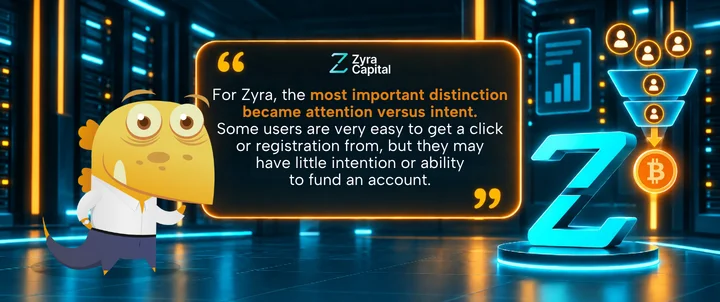
For us, the most important distinction became attention versus intent. Some users are very easy to get a click or registration from, but they may have little intention or ability to fund an account. Others click less impulsively, spend more time researching, and ultimately represent much more commercial value.
As a result, two campaigns can generate the same number of registrations while producing completely different business outcomes.”
That distinction becomes more useful once advertisers look at where those different levels of intent come from. A channel that delivers attention isn’t necessarily the one that brings users closest to taking meaningful action.
Implementation
Measure channels by the customers they create, not the clicks they collect.
Q2: Which channels bring attention, and which ones bring higher-intent users?
Timothy Bachmann
“Broad crypto placements are useful for awareness and discovery. Higher-intent behavior, however, tends to appear when the surrounding content already puts users in a financial mindset, whether that’s market analysis, trading, portfolio management, Bitcoin, stablecoins, or investment research.
So, the key question isn’t just where the ad appears, but also what the user was thinking about before seeing it. Two clicks can look identical in analytics while still coming from completely different types of customers.”
Knowing where higher-intent users come from is only part of the equation. The next challenge is identifying which campaign variables actually influence their journey after arrival.
Implementation
Test for what moves users forward, not just what gets them through the door.
Q3: What did you test: creatives, messaging, targeting, placements, timing, landing pages?
Timothy Bachmann
“We tested creatives, headlines, country targeting, placements, traffic sources, landing pages, registration flows, trust messaging, educational versus promotional angles, urgency, and calls to action.
But the important part is what happens after the test. Our funnel tracking allows us to look beyond clicks and registrations to compare how different traffic sources behave further along the journey.
- Did users explore the product?
- Did they return?
- Did they register?
- Did they activate?
- Did they move toward funding?
Looking at these signals helps both our marketing and product teams improve together. After all, better traffic can’t fix a confusing product experience.”
That broader view of testing also changes how campaign formats should be judged. Instead of asking which format wins in isolation, advertisers can consider the role each one plays at a particular stage of the decision process.
Implementation
Give every format one job: attract, educate, reassure, or re-engage.
Q4: Which campaign format worked best for you?
Timothy Bachmann
“We don’t believe there’s one magic format. Banners are useful for testing messaging and quickly generating awareness, while educational content is helpful when the product requires more explanation. Social content also plays an important role by building confidence and showing that the company is active and communicating.
In our experience, however, the overall journey matters more than any individual format. A user may see an ad, leave, read an article later, check social media, return, register, and only then deposit.
For a financial product, expecting one banner to create an immediate deposit is probably asking too much from one rectangle on the internet.”
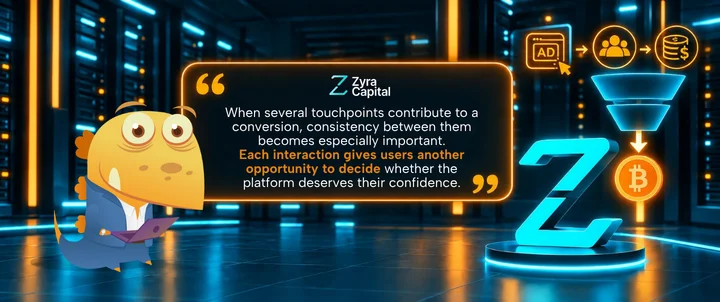
When several touchpoints contribute to a conversion, consistency between them becomes especially important. Each interaction gives users another opportunity to decide whether the platform deserves their confidence.
Implementation
Make every touchpoint reinforce the same reason to trust you.
Q5: What makes a crypto user confident enough to sign up, deposit, or connect a wallet?
Timothy Bachmann
“Trust builds in stages. Before taking action, users want to understand:
- What does the product actually do?
- Who is behind the company?
- How do withdrawals work?
- What are the risks?
- Is the support real?
- Does the platform feel professionally built?
The larger the potential allocation, the less useful hype becomes.
We also use detailed first-party analytics and funnel tracking to understand where users spend their time, where they hesitate, and which parts of the experience create friction.
Ultimately, the goal is simple: make the platform clearer, easier to understand, and more comfortable to use. An ad can earn attention, but trust has to earn the deposit.”
But even strong trust signals can’t compensate for the fact that people were never likely to invest. That makes how advertisers define a qualified crypto audience just as important as how they communicate with it.
Implementation
Define a qualified audience by what users do, not what they’re interested in.
Q6: What should advertisers stop assuming about crypto users?
Timothy Bachmann
“Advertisers should stop assuming that crypto interest automatically equals investment intent. You can have a great CTR, cheap registrations, and impressive-looking campaign numbers while still attracting users with very little chance of ever becoming funded customers.
That’s why we learned to distinguish between interest, registration, and genuine commercial intent. They aren’t the same thing, and ultimately, traffic quality matters much more than traffic volume.”
Once advertisers stop treating every crypto-interested user as equally valuable, some behaviors become easier to interpret. In particular, hesitation doesn’t always indicate low intent when users evaluate a financial product.
Implementation
Don’t mistake research for drop-off. Track signals indicating users are still evaluating.
Q7: What surprised you most about crypto users’ behavior, and which assumptions proved wrong?
Timothy Bachmann
“What surprised us most was how much research serious users actually do. Users considering larger allocations often visit multiple times, explore different pages, check social channels, read security information, and even contact support before taking action.
Our analytics showed that a user who doesn’t make a deposit on the first visit isn’t necessarily a failed acquisition. Sometimes, they’re simply doing what a rational person should do before making a financial decision. At the same time, the user asking, ‘How much will I make tomorrow?’ is usually not the one we expect to become our largest client.
An assumption was that experienced crypto users would naturally understand a sophisticated product more quickly. In reality, even sophisticated users still want simple answers:
- What happens to my capital?
- How does the strategy work?
- What are the risks?
- How do withdrawals work?
- Why is this different?
Our user-interaction data reinforced this repeatedly. When many users hesitate at the same point, we don’t assume the users are the problem. Instead, we assume the explanation is the problem. Complex technology doesn’t require complex communication.
Our biggest overall takeaway is that the crypto advertising market is maturing. Hype can still generate attention, but attention and commercial value are very different things.”
This also changes what an effective crypto creative needs to accomplish. The goal isn’t simply to remove every point of hesitation or make the message louder, but to give the right users enough clarity to make a confident decision.
Implementation
Match the message to the moment: earn attention first, then earn confidence.
Q8: What would you recommend to crypto advertisers in terms of messaging and creative style?
Timothy Bachmann
“Don’t optimize for the cheapest registration. Instead, optimize for the most valuable user. We try to look at the entire funnel: Click → Visit → Engagement → Registration → Activation → Deposit → Retention.
CTR tells you whether the ad attracted attention, while registration tells you whether the proposition created interest. Deposit behavior shows whether the user trusted it enough to act, and retention ultimately tells you whether you acquired the right customer.
Clicks are easy to celebrate. Customers are harder.
For us, the right approach is professional and data-driven, but with enough personality to still feel human. Crypto audiences understand humor and bold creatives, and we use that too. However, once real money is involved, the experience has to become much more serious.
Our philosophy is simple: Personality wins attention. Professionalism wins trust. The ad can make someone smile, but the product should make them comfortable.”
About Zyra Capital
Zyra Capital builds technology for autonomous trading across global crypto markets. Its infrastructure connects multiple exchanges, processes market data in real time, and automatically identifies and executes trading opportunities across strategies such as cross-exchange, triangular, and basis trading.
The company has been developing this infrastructure since 2021, with connections to more than 50 exchanges and over 5 million trades executed to date.
By combining AI, deep learning, and reinforcement learning with automated execution, Zyra Capital operates in a space where both technology and trust matter. That makes it a strong example of why campaign performance should be measured beyond the initial click, especially when attracting users who need confidence before committing capital.
Closing
Bachmann’s experience points to a simple takeaway. Clicks, CTR, and registrations still matter, but they are only part of the journey. What happens next depends on the quality of the audience, the relevance of the message, the trust a brand builds, and the experience users have after they click.
This closely reflects the findings in The Crypto Native Buyer. Crypto users are not one homogeneous audience, and attention alone does not guarantee action. In many cases, trust can matter more than price, while the channels that generate clicks are not always the ones that ultimately build confidence and drive conversion.
Want to see how this translates into real campaign performance? Read the Zyra Capital case study.
For more perspectives from crypto advertisers, read our interview with Vivian Laurant and our conversation with a representative from TheCryptoHub.io.
You can also download The Crypto Native Buyer to explore all five buyer personas and get practical insights for better targeting, messaging, and channel planning.