







“A large audience is not necessarily a valuable audience. Broad campaigns can generate impressions and clicks, but smaller, more relevant audiences often deliver better conversion quality.”
UPay operates in both B2B and B2C acquisition, but this campaign had a focused objective: to promote its white-label card issuance solution to crypto and fintech businesses looking to launch physical and virtual cards under their own brand.
For UPay, the priority was not simply generating more traffic. It was reaching businesses with a genuine need for the product and building credibility throughout the journey. Coinzilla supported this approach by combining targeted visibility across crypto-native environments, clear, benefit-led creative, and ongoing campaign optimization.
The Constraint
UPay’s white-label card issuance solution addresses a specific B2B need. As a result, broad crypto exposure alone would not be enough. The campaign needed to reach companies within the crypto and fintech ecosystem that could realistically benefit from launching their own branded payment card program.
This made audience quality more important than audience size. Awareness still mattered, particularly for strengthening brand recognition and trust, but the campaign ultimately needed to attract prospects with a clear reason to explore UPay’s solution and potentially submit an inquiry or book a meeting.
The challenge was therefore to balance reach with relevance: generate enough visibility to build recognition while concentrating spend on the environments, markets, and audiences showing the strongest engagement.
Key Achievements
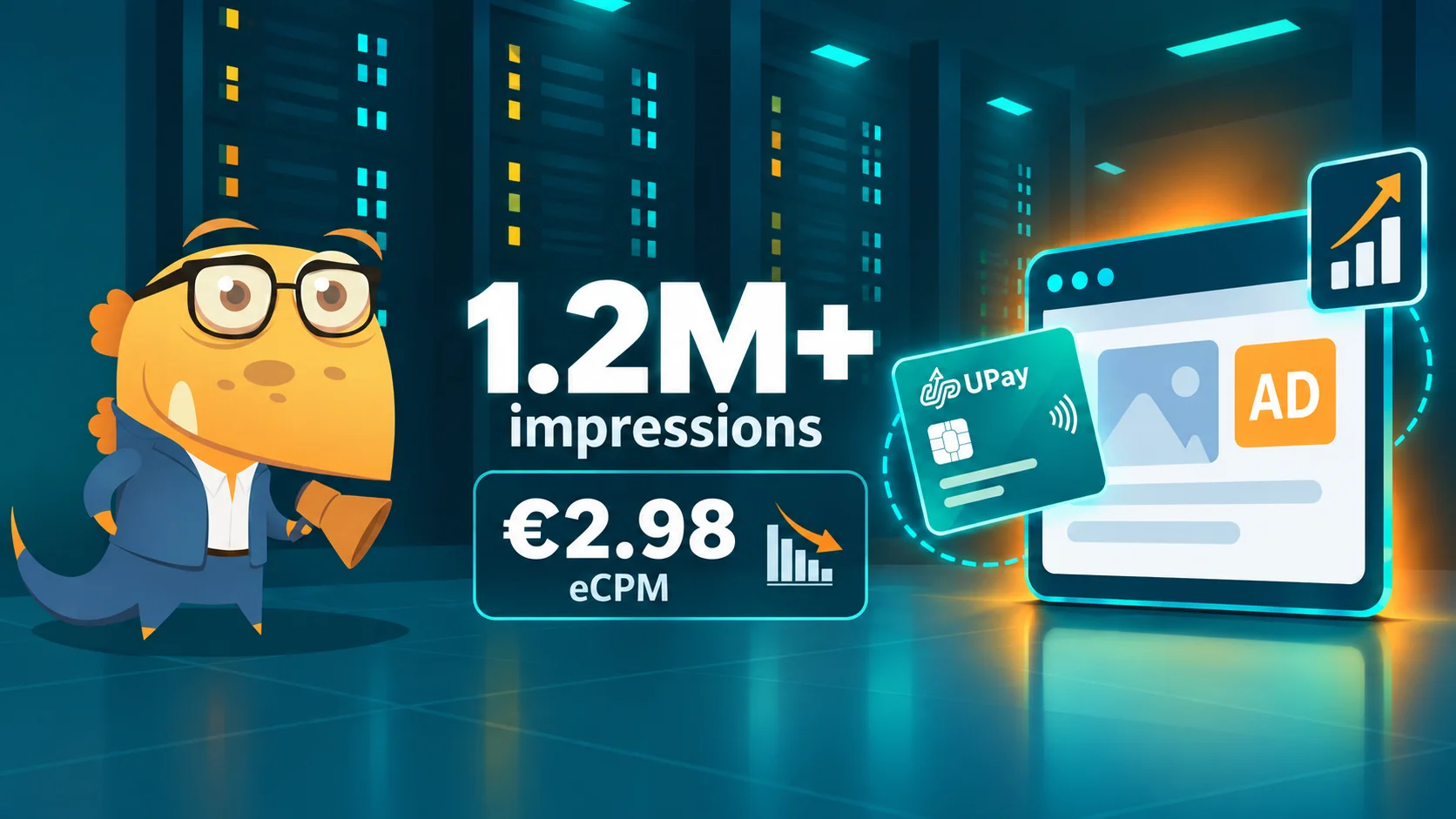
1.2M+ targeted impressions
Delivered across crypto and finance environments at an average €2.98 eCPM.
1,870 clicks generated
With campaign CTR reaching 0.37% at its strongest point.
Actionable audience insights
Identified through ongoing optimization of placements and geographic markets.
Introduction to UPay
UPay Business is the enterprise division of UPay.com, a fintech company founded in 2023. It helps fintech companies, crypto exchanges, and money service operators launch branded virtual and physical payment cards without building their own card-issuing infrastructure.
Through its white-label card issuance solution, businesses can customize their card design and branding, while UPay handles the infrastructure behind the program, including card issuance, production, delivery, KYC, AML, and compliance. The solution connects assets such as BTC, ETH, USDT, and USDC to the global Visa payment network and supports multiple blockchains, including TRC20, ERC20, and BSC.
UPay also offers an open API that enables businesses to issue cards, manage balances, and track transactions in real time. This allows partners to integrate card functionality directly into their existing products and provide customers with a seamless payment experience.
Today, UPay reports more than 130 partners, over 320,000 cards issued, support across 180+ countries, and access to more than 55 million merchants. The platform is also trusted by more than 300,000 users worldwide.
With experience across both B2B and B2C acquisition, UPay has seen how crypto audiences have become more selective. Users increasingly compare solutions, research the companies behind them, and look for trust, transparency, credibility, and practical value before taking meaningful action.
For a specialized B2B product, this makes relevant visibility and a clear value proposition essential parts of the acquisition process.
Coinzilla’s Approach
UPay approaches acquisition as a complete journey rather than evaluating an ad click in isolation. Through its wider marketing activity, the company has tested funnels, landing pages, forms, creative, messaging, targeting, retargeting, placements, timing, markets, and regions to understand what drives meaningful action.
Coinzilla’s campaign supported that broader philosophy by combining crypto-native reach with continuous optimization. Rather than treating “crypto users” as one homogeneous audience, the strategy concentrated on relevant environments and used campaign data to progressively refine where UPay’s message appeared.
STEP 1: Relevant Placement, Not Maximum Placement
The campaign placed UPay within environments where users were already consuming crypto and financial content. Coinzilla ran Display and Native advertising across its network, including prominent crypto platforms such as DEXTools, Etherscan, BscScan, and CoinMarketCap.
Targeting covered markets including the United States, Indonesia, Vietnam, Canada and countries across different regions, with campaigns running across desktop and mobile devices.
This served two purposes. First, it generated traffic from audiences already engaged with the category. Second, repeated visibility across recognizable crypto environments supported UPay’s emphasis on brand credibility and trust.
For a B2B financial product, repeated exposure matters. Prospects may not convert after seeing a single ad, but familiarity with a recognizable brand across relevant environments can strengthen confidence when they later encounter the product through another channel or return to evaluate it more closely.
STEP 2: Creative Built Around One Clear Benefit
UPay’s approach to advertising creative is straightforward: one benefit, a clear product visual, recognizable branding, and a direct call to action. That principle was particularly important for a specialized B2B solution, where an ad has only a few seconds to communicate why the product is relevant.
The campaign, therefore, centered its message on a clear proposition: “Launch physical and virtual cards under your brand using UPay’s complete white-label solution.”
Rather than overwhelming prospects with technical features, the creative made the core business benefit immediately understandable. Interested users were then directed to UPay’s dedicated White Label Card Issuance for Businesses landing page, where they could explore the solution in greater detail and connect with UPay’s card-issuing team.
In this way, the banner was not expected to do the entire job. Its role was to capture attention and quickly communicate relevance, while the landing page continued the conversion journey.
STEP 3: Active Optimization Through Subtraction
The campaign ran between May and August 2026.
UPay began with a smaller budget across Display and Native campaigns and increased investment as performance data became available. This allowed the team to validate engagement before committing additional budget.
Throughout the campaign, performance was refined by removing website zones and geographic markets with weaker CTRs. Instead of continuously expanding reach, optimization focused on concentrating spend where audiences were responding.
This process highlighted several stronger-performing areas. CoinMarketCap and DEXTools generated notable CTR performance for Display advertising, while the United States, Indonesia, and Vietnam emerged as the leading traffic markets.
Key Performance Indicators

To evaluate whether the campaign was building meaningful visibility among UPay’s target audience, Coinzilla focused on indicators that could inform both reach and optimization.
- Impressions and eCPM measured the campaign’s ability to efficiently build visibility across crypto-focused environments.
- CTR by placement and zone showed where UPay’s message generated stronger engagement and helped identify placements to deprioritize.
- Geographic performance revealed which targeted markets responded most strongly, allowing the campaign to focus resources more effectively.
Together, these indicators provided more than a top-line view of traffic. They helped identify where UPay’s message was resonating and where campaign spend could be used more efficiently.
Results & Impact
Throughout the campaign, UPay generated more than 1.2 million impressions at an average eCPM of €2.98. The significance was not reach alone, but where that reach occurred. Coinzilla placed UPay within crypto and finance environments where audiences were already engaging with digital assets, financial products, and related services. This supported both sides of UPay’s strategy: building broader brand recognition while maintaining proximity to audiences with a stronger contextual connection to the product.
The campaign generated 1,870 clicks, with a peak CTR of 0.37%. More importantly, engagement data became an optimization tool. Instead of responding to performance by simply widening targeting, Coinzilla used CTR patterns to identify stronger placements and reduce exposure in weaker-performing zones and markets. This reflected a key principle behind UPay’s acquisition strategy: more traffic is not automatically better traffic. For specialized products, smaller audience segments with stronger relevance can ultimately be more valuable than maximum reach.
The United States, Indonesia, and Vietnam emerged as the campaign’s strongest traffic markets, alongside broader targeting across Canada, Brazil, and Europe. These differences helped UPay see where its B2B proposition was generating the strongest response and provided useful direction for future acquisition activity. Rather than viewing geographic targeting as a fixed campaign setting, the results showed the value of treating it as something that can be tested and refined. When certain markets or placements demonstrate stronger engagement, the budget can be concentrated accordingly. Ultimately, the campaign reinforced the role specialized advertising can play within a broader acquisition strategy: broad channels can build awareness, intent-led environments can capture more relevant demand, and continued optimization can connect the two more efficiently.
Testimonial: UPay on Coinzilla’s Advertising Power
“For us at UPay, effective B2B advertising isn’t about being everywhere. It’s about reaching the right businesses in the right context. With Coinzilla, we were able to put our card issuance and payment services in front of relevant businesses across the crypto ecosystem, helping us build valuable connections and create new business opportunities.”