







 Bogdan Cretu
 2026 is the year the grace periods ended. MiCA’s transitional regime closed on July 1 with no extension, China replaced its 2021 crypto framework in February, and the UK’s new cryptoassets regime passed on February 4.
The compliance question has moved upstream. It is no longer only whether your creative carries the right disclaimer, but whether you are authorized to offer the service in the target market and whether platforms such as Google Ads and Meta permit that license, and jurisdiction combination. This guide covers MiCA, platform approval processes, licensing requirements, and country-specific rules.
Table of Contents
What’s New in Crypto Advertising Regulations (2026)
- MiCA’s transitional period expired on July 1, 2026. Article 143(3) lets CASPs active before December 30, 2024, continue under national regimes for up to 18 months. Germany and Ireland closed on December 31, 2025; the Netherlands, Poland, Latvia, Hungary, and Slovenia chose a 6-month period. ESMA confirmed there is no extension.
- Google now requires CASP authorization across the EU. From July 1, 2026, it will no longer accept the AMF’s DASP registration in France, and from August 2026, it will extend crypto advertising to Iceland, Liechtenstein, and Norway on the same basis. Certification applications moved into the Google Ads account in June 2026.
- The UK’s new regime is fixed and dated. The Cryptoassets Regulations 2026 were passed on February 4, with final FCA rules on June 30, 2026, in PS26/9 to PS26/12. The application period is scheduled to open on September 30, 2026, and close on February 28, 2027, with the new regime expected to take effect on October 25, 2027.
- Mainland China replaced its 2021 framework. Yin Fa [2026] No. 42, issued by eight departments on February 6, 2026, repealed Yin Fa [2021] No. 237 and extended the perimeter to real-world-asset tokenization.
- Australia’s transition remains open. On June 25, 2026, ASIC extended its sector-wide no-action position for eligible digital-asset businesses from June 30 to September 30, 2026.
Common Global Requirements
Three principles recur across major markets: no guaranteed-return claims, no concealed paid promotion, and no omission of material risks. Whether a formal risk warning is required and its exact wording depend on the jurisdiction and the product. Everything below is a drafting principle, not a compliance checklist. The wording is jurisdiction-specific and, in places, incompatible, so do not run a single creative across all markets.
- DO NOT claim crypto assets are risk-free or guaranteed to appreciate, or present forward-looking statements as promises.
- DO NOT target people who lack financial literacy or are identified as vulnerable consumers.
- DO NOT use misleading visuals, testimonials, or celebrity endorsements implying guaranteed results, or advertise crypto as a substitute for savings, pensions, or insurance.
- DO NOT omit risk warnings on volatility, loss of capital, or lack of investor protection, or use language suggesting quick profits.
- DO NOT promote crypto without disclosing your relationship to the issuer or platform. In the US, Section 17(b) requires the amount, not just the existence, of consideration.
- DO NOT present an AML registration, such as FINTRAC MSB status, as a license, or encourage credit-financed purchases.
- DO NOT use influencers who fail to disclose paid partnerships. In the UK, a paid influencer acting in the course of business is making a financial promotion.
- DO NOT omit the statement that a marketing communication is not approved by a competent authority where that rule applies.
- DO NOT include a call to buy in marketing of a virtual asset in or targeting the UAE.
- DO NOT discard marketing records. VARA requires eight years.
United States (US)

Active frameworks that regulate crypto advertising
- Securities Act of 1933, in particular Section 17(b), the anti-touting provision
- Securities Exchange Act of 1934
- The Howey Test
- Commodity Exchange Act
- Bank Secrecy Act / FinCEN rules
- FTC Act Section 5 and the FTC Endorsement Guides
- GENIUS Act (2025), enacted but not yet effective
How crypto advertising is regulated in the US
There is no single crypto advertising law. The applicable regulator and legal standard depend on what is being promoted and how the advertiser operates.
Where a token is offered as a security under the Howey Test, federal securities rules may apply. Where a cryptoasset is a commodity, the Commodity Exchange Act may cover derivatives, leveraged retail transactions, fraud, manipulation, and other conduct within the CFTC’s jurisdiction. Commodity status alone does not place every spot-market promotion under a general CFTC advertising regime.
The FTC separately addresses deceptive advertising and endorsements, while FinCEN and state regulators may impose registration and licensing requirements on businesses that transmit or exchange virtual currency. Advertising does not usually create these licensing duties on its own, but it can expose an unlicensed service to US customers.
The rule that bites most often is Section 17(b): promoting a security for consideration without disclosing the nature, source, and amount of that consideration. The SEC does not need to prove that the promoter intended to deceive investors. The rule applies to paid influencers and affiliates, not only issuers.
A clear and conspicuous “#ad” disclosure may satisfy FTC requirements in the right context, but the FTC assesses placement, visibility, wording, and platform format on a case-by-case basis. It does not satisfy Section 17(b), which requires more detailed compensation disclosure.
The GENIUS Act, signed on July 18, 2025, adds stablecoin marketing rules. Section 4(e)(3) makes it unlawful to market a product in the US as a payment stablecoin unless it is issued under the Act, and Section 4(e)(2) prohibits representing that it is backed by the full faith and credit of the United States, guaranteed by the government, or federally insured.
These prohibitions are not yet operative. The Act takes effect on the earlier of January 18, 2027, or 120 days after final federal rules. As of July 31, 2026, the principal OCC and FDIC implementing rules remained at the proposed stage.
Sanctions for non-compliance
The SEC uses three civil penalty tiers. Tier 1 covers the underlying violation, Tier 2 applies where the conduct involves fraud, deceit, manipulation, or reckless disregard of a regulatory requirement, and Tier 3 also requires substantial losses, a significant risk of such losses, or substantial financial gain. These are maximums, not automatic fines.
For relevant federal court actions, current Tier 3 limits can reach $236,451 per violation for a natural person and $1,182,251 for an entity. The SEC may also seek disgorgement, prejudgment interest, injunctions, and restrictions on future promotional activity.
In October 2022, Kim Kardashian settled for $1.26 million over an undisclosed EthereumMax promotion, including a $1 million civil penalty. In February 2023, Paul Pierce settled for approximately $1.4 million. Both cases involved failures to disclose paid promotion, and the settlement totals combined several remedies rather than representing a standard advertising fine.
For commodity-related misconduct, CFTC penalties depend on the violated provision. For commodity-type tokens, the CFTC’s measure for manipulation is the greater of $1,000,000 per violation or triple the monetary gain.
Once the GENIUS Act takes effect, knowingly marketing a non-compliant product as a payment stablecoin can attract a Treasury fine of up to $500,000 per violation. Unlawful issuance is separate and can result in fines of up to $1 million per violation, imprisonment for up to five years, or both.
European Union (EU)

Active frameworks that regulate crypto advertising
- Markets in Crypto-Assets Regulation (MiCA)
- Digital Services Act (DSA)
- General Data Protection Regulation (GDPR)
- Unfair Commercial Practices Directive (UCPD) & national advertising rules
- Audiovisual Media Services Directive (AVMSD)
How crypto advertising is regulated in the EU
Since July 1, 2026, firms providing crypto-asset services within MiCA’s scope generally need authorization to continue actively offering or marketing those services in the EU. Non-EU firms cannot rely on reverse solicitation where they solicit, promote, or advertise services to EU clients.
ESMA treats reverse solicitation as a narrow exception based on the client’s own exclusive initiative. It applies to retail and professional clients, so contractual disclaimers, B2B status, or a claim that the client approached first will not help where the firm previously advertised or solicited in the EU.
The marketing rules are narrower than usually reported. Article 7 MiCA applies only to marketing relating to an offer to the public or admission to trading of a crypto-asset other than an asset-referenced token (ART) or e-money token (EMT).
Those communications must be identifiable as marketing, fair, clear, and not misleading, consistent with the white paper where required, and carry the prescribed statement that no EU competent authority has reviewed or approved them. Article 29 covers ARTs and Article 53 covers EMTs.
A licensed CASP advertising its own exchange or custody service is not automatically inside Article 7. Article 66 separately requires CASP information, including marketing communications, to be fair, clear, and not misleading, identifiable as marketing, and accompanied by appropriate warnings about transaction risks. Use the Article 7 disclaimer for covered offer or admission campaigns, not automatically for every CASP brand ad.
National Competent Authorities enforce MiCA, with ESMA and EBA coordinating their respective areas. The DSA requires ad transparency and prohibits profiling-based ads to known minors; GDPR governs personal-data targeting, while UCPD, AVMSD, and national laws prohibit misleading claims.
Sanctions for non-compliance
Article 111 MiCA uses different penalty bands according to the breached provisions:
- Breaches of Articles 4 to 14, including Article 7 marketing rules: legal persons face maximum fines of at least €5,000,000 or 3% of annual turnover, and natural persons at least €700,000.
- Breaches of ART provisions, including Article 29, and EMT provisions, including Article 53: legal persons face at least €5,000,000 or 12.5% of annual turnover.
- Breaches of CASP authorization and conduct rules, including Article 66: legal persons face at least €5,000,000 or 5% of annual turnover.
- Regulators must also be able to impose up to twice the profit gained or loss avoided, even where that amount exceeds the fixed or turnover-based maximum.
For consolidated groups, turnover is measured using the ultimate parent’s consolidated accounts, and Member States may set higher ceilings. Authorities can also identify the responsible person publicly, order the infringement to stop, suspend services, withdraw authorization, and impose temporary management bans. Separate DSA fines can reach 6% of worldwide annual turnover, while serious GDPR breaches can reach €20 million or 4%, whichever is higher.
United Kingdom (UK)

Active frameworks that regulate crypto advertising
- Financial Services and Markets Act 2000 (FSMA), Financial Promotions Regime
- Financial Promotion Order 2005 (SI 2005/1529), as amended by the Financial Promotion (Amendment) Order 2023 (SI 2023/936)
- FCA Policy Statement PS23/6 and Guidance FG23/3
- Financial Services and Markets Act 2000 (Cryptoassets) Regulations 2026
How crypto advertising is regulated in the UK
Since October 8, 2023, the UK has run one of the world’s strictest regimes. A qualifying cryptoasset promotion capable of having an effect in the UK is lawful only via one of four routes:
- An FCA-authorized person communicates it.
- An unauthorized person communicates it after approval by an FCA-authorized firm with permission to approve financial promotions.
- An FCA-registered cryptoasset business communicates its own promotion under the Money Laundering Regulations. It cannot approve promotions for third parties.
- The promotion falls within an applicable exemption under the Financial Promotion Order, although the available cryptoasset exemptions are narrow.
A promotion communicated outside these routes breaches section 21 of the FSMA and can constitute a criminal offense, not merely a platform policy violation.
Qualifying cryptoassets are Restricted Mass Market Investments. Promotions must be fair, clear, and not misleading, and carry the prescribed warning: “Don’t invest unless you’re prepared to lose all the money you invest. This is a high-risk investment, and you should not expect to be protected if something goes wrong. Take 2 mins to learn more.” Where required, the warning must appear prominently and link to the standardized risk summary.
Direct offer promotions to first-time investors with the firm require a personalized risk warning and a 24-hour cooling-off period. Retail clients must also pass an appropriateness assessment and be categorized as restricted, high-net-worth, or self-certified sophisticated. Non-intrinsic incentives, including refer-a-friend bonuses, are banned.
The regime applies to overseas promotions capable of having an effect in the UK. An accessible website or social account can therefore create exposure, particularly where UK users are not effectively restricted.
Sanctions for non-compliance
Breaching section 21 is a criminal offense punishable by up to 2 years’ imprisonment, an unlimited fine, or both. The FCA may also issue cease-and-desist orders and add firms to its warning list.
The leading case is HTX. On October 21, 2025, the FCA began High Court proceedings against Huobi Global S.A. and connected persons, announced on February 10, 2026, seeking a declaration of breach and an injunction. The FCA alleges that HTX promoted its services through its website and on TikTok, X, Facebook, Instagram, and YouTube without using lawful promotional routes. Proceedings remain at the pre-trial stage, so there is currently no judgment or financial penalty.
What changes next
The Cryptoassets Regulations 2026 bring additional crypto activities within the FCA perimeter. Final rules arrived on June 30, 2026, covering admissions and market abuse, stablecoin issuance, regulated activities, and prudential requirements. The application period runs from September 30, 2026, to February 28, 2027, and the new regime is expected to take effect on October 25, 2027. Qualifying cryptoassets remain RMMIs; UK-issued qualifying stablecoins will not be.
United Arab Emirates (UAE)

Active frameworks that regulate crypto advertising
- Federal Decree-Law No. 6 of 2025 (Central Bank and financial activities)
- VARA Marketing Regulations 2024 (Dubai)
- SCA rules for onshore virtual asset platform operators
- CBUAE Payment Token Services Regulation
- DFSA crypto token regime (DIFC), amended effective January 12, 2026, and the FSRA virtual asset framework (ADGM)
How crypto advertising is regulated in the UAE
Federal Decree-Law No. 6 of 2025, published on September 16, 2025, replaces the Central Bank law. It expands licensed financial activities to include certain payment and financial services using virtual assets. It is primarily a licensing statute, not a standalone crypto advertising code, but it determines who may lawfully provide and promote activities within the CBUAE perimeter. Financial free zones remain subject to their own regulators.
In Dubai, VARA’s Marketing Regulations, in force since October 1, 2024, apply to all marketing of or relating to any virtual asset or VA activity in or targeting the UAE, by licensed and unlicensed entities alike, domestic or foreign. An overseas campaign reaching UAE consumers is in scope. All such marketing must:
- Be fair, clear, and not misleading, and clearly identifiable as marketing
- Not state or imply that investments are safe, low risk, or guaranteed, or that decisions are trivial or easy
- Not present past performance as indicative of future results
- Not create urgency or fear of missing out
- Not promote acquisition using credit unless the entity is VARA-licensed to provide it
- Disclose clearly where third-party content is posted under a remunerated arrangement
Marketing of a virtual asset carries three further rules: no call to buy or messaging that directs purchase or sale, a prominent disclaimer about volatility and total loss, and a statement that the investor has no financial protection.
Marketing records must be kept for at least eight years. Where an agency runs the campaign, the instructing entity remains responsible throughout, and the agency can also be liable.
Outside free zones, the SCA oversees onshore activity. In the DIFC, the DFSA regulates crypto tokens, with its amended regime from January 12, 2026, placing token suitability on regulated firms. In ADGM, the FSRA operates its own framework.
Sanctions for non-compliance
Under Federal Decree-Law No. 6 of 2025, unlicensed operation carries penalties reported at up to AED 1 billion (approximately US$272 million), plus criminal liability for responsible individuals. That ceiling attaches to unlicensed provision of a regulated activity, not to a single misleading ad.
VARA’s Schedule 1 sets fines per violation. Up to AED 10,000,000 applies to the general marketing requirements, the virtual asset requirements, marketing of VA activities, platform facilitation, physical events, and marketing from the Emirate into other jurisdictions. Up to AED 2,000,000 applies to third-party marketing, misuse of the journalistic or educational exemptions, and app store operation. Up to AED 500,000 applies to platform record-keeping. A repeat violation within one year doubles the fine. Unpaid fines also accrue an additional 1% per month, compounded.
Singapore

Active frameworks that regulate crypto advertising
- MAS Guidelines on Provision of Digital Payment Token Services to the Public (PS-G02)
- Payment Services Act and Securities and Futures Act
- Financial Services and Markets Act 2022, Part 9, the DTSP regime
How crypto advertising is regulated in Singapore
Singapore largely prohibits public promotion of DPT services while allowing licensed providers to publish responsible information through their own corporate channels. PS-G02 states that DPT service providers should not promote their services to the general public in Singapore through public or third-party channels.
MAS identifies restricted channels, including public transport and transport venues, broadcast and print media, public events and roadshows, third-party websites, social-media banners or pop-ups aimed at the general public, and influencers. Providers may publish information on their own corporate websites, apps, official social media accounts, and physical premises, provided the content does not trivialize DPT trading risks.
Since June 30, 2025, Part 9 of the FSM Act also requires Singapore-incorporated entities providing digital token services solely to customers outside Singapore to hold a DTSP license. MAS has said the licensing threshold is high and that it will generally not issue licenses, with no transitional exemption for firms already operating.
Sanctions for non-compliance
These are two regimes and should not be merged. PS-G02 is a guideline, not a standalone statutory offense, and carries no prescribed financial penalty. MAS may consider non-compliance during supervision, licensing, renewal, and fitness assessments.
Licensing offenses are separate and criminal. Breaching section 137 of the FSM Act by providing digital token services outside Singapore without a license can attract a fine of up to SGD 250,000 (approximately US$195,000), imprisonment for up to three years, or both. The penalty applies to unlicensed operation, not automatically to a non-compliant advertisement.
China

Active frameworks that regulate crypto advertising
- Notice on Further Preventing and Handling Risks Related to Virtual Currencies (Yin Fa [2026] No. 42), issued by the PBOC and seven other departments, in force February 6, 2026, repealing Yin Fa [2021] No. 237
- Advertising Law of the People’s Republic of China, as amended
How crypto advertising is regulated in mainland China
Notice No. 42 prohibits a defined list of virtual-currency business activities as illegal financial activities: fiat-to-crypto and crypto-to-crypto exchange, acting as central counterparty, information intermediary, and pricing services, token issuance financing, and trading of crypto-related financial products. Offshore entities may not provide virtual-currency services to domestic entities in any form. Real-world asset tokenization is also prohibited domestically, except on specified financial infrastructure with the competent authority’s consent.
Two provisions govern advertising directly. Article (7) prohibits internet companies from providing online business premises, commercial display, marketing and promotion, or paid traffic diversion to virtual-currency or RWA business activities, and directs authorities to close offending websites, apps, including mini-programs, and public accounts. Article (8) bars the terms virtual currency, virtual asset, cryptocurrency, crypto asset, stablecoin, real-world asset tokenization, and RWA from registered company names and business scopes, and directs market regulators to police advertising in this area.
The question is not whether the word “wallet” or “crypto” appears, but whether the promoted activity falls within the prohibited list.
Sanctions for non-compliance
Article (18) provides that breaches are punished under applicable law, with criminal liability where conduct constitutes a crime, and extends liability to domestic parties who knowingly assist offshore entities serving the mainland. The Notice sets no fine tariff itself, so figures should be sourced to the applicable Advertising Law or Criminal Law article. Authorities can also seize assets, block websites, and ban individuals from financial activity.
Hong Kong
Hong Kong is a separate jurisdiction from mainland China and takes the opposite approach: crypto business is permitted and licensed.
All centralized virtual asset trading platforms operating in Hong Kong, or actively marketing to Hong Kong investors, must be SFC-licensed. Marketing is itself a trigger for licensing, so an unlicensed offshore platform advertising in Hong Kong is not merely running a non-compliant ad.
Under the Stablecoins Ordinance (Cap. 656), commenced August 1, 2025, only HKMA-licensed issuers’ fiat-referenced stablecoins may be offered to Hong Kong retail investors, and advertising an unlicensed one is an offense in its own right.
Canada

Active frameworks that regulate crypto advertising
- CSA/IIROC Staff Notice 21-330 on advertising, marketing, and social media use (September 23 2021), still operative. Note that IIROC merged with the MFDA in 2023, and the successor body is now CIRO.
- Provincial securities legislation
- FINTRAC registration and MSB requirements under the Proceeds of Crime (Money Laundering) and Terrorist Financing Act
How crypto advertising is regulated in Canada
Where a platform facilitates assets that may qualify as securities or derivatives, the CSA and CIRO expect advertising and social content to comply with securities legislation and dealer rules. Platforms must avoid implying regulatory approval that does not exist, gambling-style contests, referral bonuses, and get-rich-quick framing.
Firms dealing in virtual currency exchange or transfer must register as MSBs with FINTRAC, and those serving Canadian customers from abroad as foreign MSBs. FINTRAC registration is an AML registration only: neither a license nor an endorsement, and it does not authorize marketing.
Sanctions for non-compliance
Canada sets no specific fine in its advertising guidance. Regulators use provincial securities powers and federal AML penalties, including cease trade orders and removal of registration.
Two Cryptomus matters show the difference between the AML track and the advertising track. On October 16, 2025, FINTRAC imposed a penalty of C$176,960,190 on Xeltox Enterprises Ltd., operating as Cryptomus, which was announced on October 22 and covered over 2,593 violations, including 1,068 failures to file suspicious transaction reports. That was a reporting case, not an advertising one.
Separately, on May 20, 2025, the British Columbia Securities Commission issued a temporary order against Cryptomus prohibiting it from trading securities or derivatives and from promotional activities. That is the advertising precedent.
Australia

Active frameworks that regulate crypto advertising
- Corporations Act 2001, financial product advertising and licensing
- ASIC Information Sheet 225 (updated 2025) and Regulatory Guide 234
- Australian Consumer Law for products that are not financial products
How crypto advertising is regulated in Australia
The threshold question is whether the digital asset is a financial product. Updated INFO 225 sets out ASIC’s view with 18 worked examples. Many stablecoins and wrapped tokens may be financial products; Bitcoin, gaming NFTs, and membership NFTs are unlikely to be.
Where the asset is a financial product, the advertiser needs an Australian Financial Services license or authorization as a corporate authorized representative. RG 234 then governs the advertising: balanced risk and return, no misleading use of past performance, clear disclosure of fees, and warnings not undermined by the dominant message.
ASIC’s class no-action position remains available until September 30, 2026, for eligible firms that satisfy the updated conditions. Crypto lending, earn products, and most crypto derivatives remained excluded throughout. It never covered misleading or deceptive conduct, so section 1041H of the Corporations Act, section 12DA of the ASIC Act, and the Australian Consumer Law applied without relief.
Influencer promotions are an active priority. In 26-081MR, ASIC issued warning notices to influencers suspected of unlicensed advice or misleading conduct. An unlicensed influencer can expose the licensee, too.
Sanctions for non-compliance
Misleading conduct and unlicensed provision of financial services carry civil penalties under the Corporations Act, alongside ASIC’s powers to issue stop orders and cancel or suspend licenses. Penalty units are indexed, so confirm current figures.
Current Regulations on Major Platforms
| Platform | Gate to entry | Prohibited outright |
|---|---|---|
| Google Ads | Licensed provider where required, Google certification for restricted categories, and an approved target location. Hardware wallets are exempt from the provider-licensing requirement but still require Google certification. Some educational, blockchain, mining-hardware, tax, legal, and NFT-gaming content may run without crypto certification. | ICOs, DeFi trading protocols, crypto loans, initial DEX offerings, token liquidity pools, unhosted software wallets, unregulated dApps, crypto trading signals, aggregators, and destinations offering crypto investment advice or facilitating prohibited trading. |
| Meta | Eligibility depends on the product and target market. Specified crypto products require prior authorization, and Meta may request evidence of licensing, registration, or other regulatory status. Some education, news, events, NFTs, and storage-only wallet services may not require crypto authorization. | ICOs and other categories identified as prohibited under Meta’s current cryptocurrency policy. Exchange, wallet, and trading-platform ads should not be described as universally prohibited because some may run after authorization. |
| TikTok | Market-specific approval. Where permitted, cryptocurrency exchanges and custodial wallets generally require local licensing, approval through a TikTok Sales Representative, and targeting restricted to users aged 18 or older. | ICOs and token sales are widely prohibited. Further restrictions on virtual currencies, exchanges, custodial or non-custodial wallets, mining devices, ATMs, NFTs, and advisory services vary significantly by market. |
| X | Prior X certification and compliance with country-specific licensing rules. Depending on the market, X may allow exchanges, wallets, crypto kiosks, cards, staking, crypto CFDs, selected DeFi services, NFTs, and blockchain games. | ICOs, IEOs, initial decentralized exchange offerings, and cryptocurrency mining advertisements. Additional products are prohibited in specific markets. |
| Coinzilla | Crypto-specific advertiser and publisher onboarding, followed by campaign, creative, targeting, and landing-page review under Coinzilla’s internal policies. Licensing evidence may be required for regulated products and markets. | Products, services, creatives, or landing pages that breach Coinzilla’s internal policies or applicable market restrictions. Coinzilla approval does not constitute regulatory approval. |
Crypto-Friendly Markets and Advertising Platforms
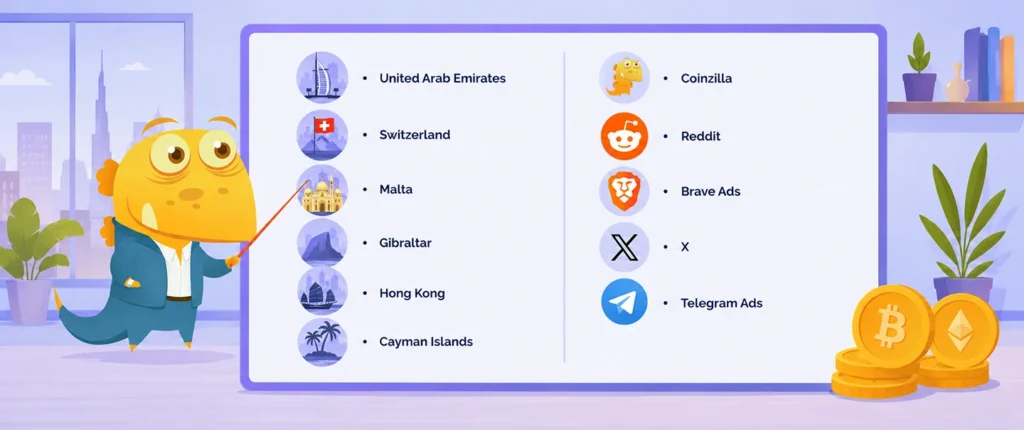
Markets with Established Crypto Licensing Frameworks
- United Arab Emirates;
- Switzerland;
- Malta;
- Gibraltar;
- Hong Kong;
- Cayman Islands.
Platforms That Accept Selected Crypto Campaigns
- Coinzilla;
- Reddit;
- X;
- Telegram Ads.
Why Coinzilla Is the Right Choice for Crypto Advertising

Coinzilla was built for the crypto and fintech industries, which gives it an advantage over general networks that retrofit policies as regulations change. It works only with crypto advertisers and publishers, vetting both sides against MiCA, the FCA regime, and local frameworks in the US, UAE, and Singapore.
Legal compliance remains the advertiser’s responsibility and cannot be transferred to any network. Under the UK regime, a promotion must run through one of the four statutory routes; under MiCA, the advertiser must hold CASP authorization where required.
FAQ
Yes, in most regulated markets, but the entry requirement has shifted from complying with the ad rules to holding the right license: MiCA CASP authorization in the EU, one of four statutory routes in the UK.
Yes, for four restricted categories: exchanges, software wallets, hardware wallets, and coin trusts. You must be a licensed provider in the target market (hardware wallets excepted), certified with Google, and targeting a location on Google’s approved list. If the location is not on that list, the ads cannot run there.
As of July 1, 2026, France will no longer accept AMF DASP registration, so MiCA CASP authorization is required across all 27 Member States. From August 2026, Google will extend crypto advertising to Iceland, Liechtenstein, and Norway. Certification applications moved into the Google Ads account in June 2026.
EU and EEA: MiCA CASP authorization. UK: FCA authorization, a section 21 approver, or FCA MLR registration for your own promotions. US: FinCEN MSB registration plus state money transmitter licensing, or a chartered bank. UAE: VARA, FSRA, or DFSA. Switzerland: FINMA. Canada: FINTRAC MSB plus provincial securities registration. Australia: an AFS license where the asset is a financial product. Hong Kong: SFC Type 1 and Type 7, or an HKMA stablecoin license.
Mainland China prohibits marketing, commercial display, and paid traffic diversion for virtual-currency and RWA business. Singapore is a partial case, permitting licensed crypto business but no promotion to the general public. Some markets are closed at the platform level too: TikTok bars virtual currency ads outright in Australia, New Zealand, and Denmark.
Final Word
The pattern across every major market this year is the same: the arrangements that let unlicensed firms advertise have closed. MiCA’s grandfathering ended on July 1, 2026, and the UAE Central Bank transition period ends in September.
Having a great crypto product is no longer enough, and neither is a clean creative. Verify the license first, then build the campaign.
Ready to launch compliant campaigns worldwide? Sign up to Coinzilla now!