



 Bogdan Cretu
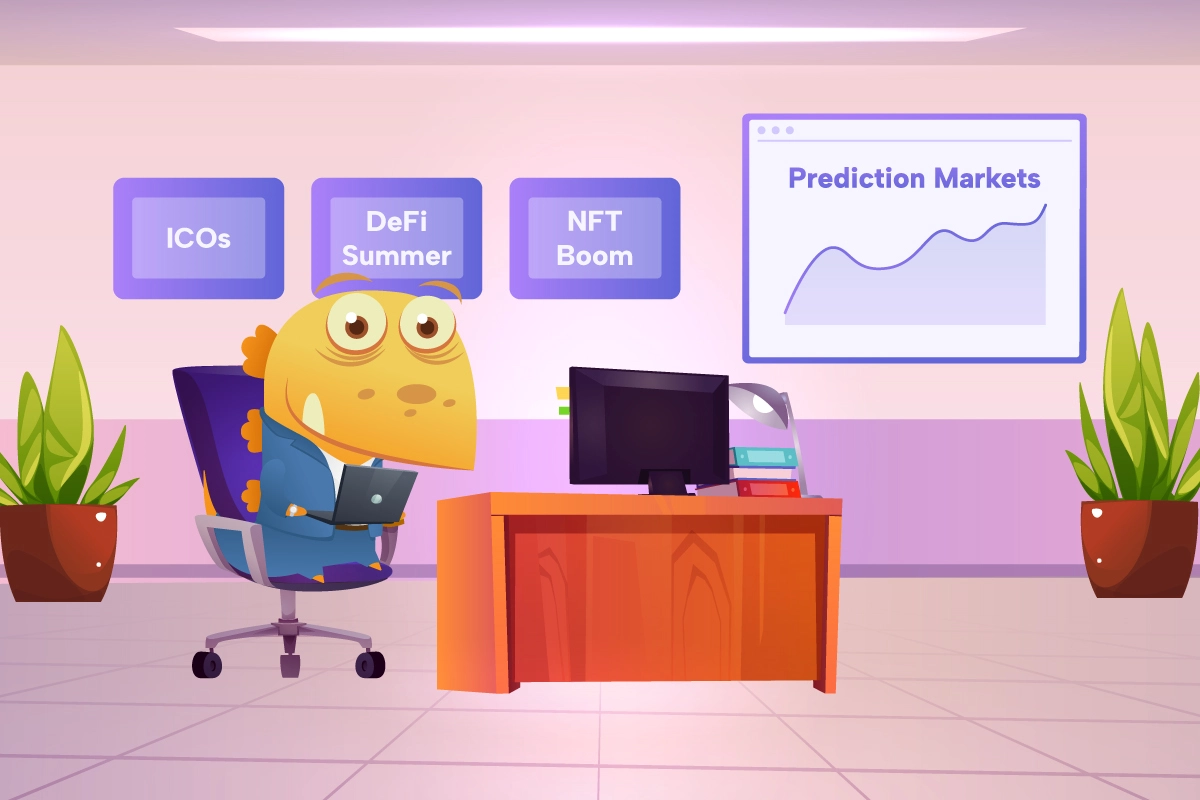
Web3 has lived through enough growth cycles for the pattern to feel familiar. ICOs, DeFi summer, and the NFT boom each brought a new product type, a new user behavior, and a short window in which early movers on distribution pulled ahead of everyone else.
Prediction markets in Web3 now follow their own version of that story. However, after watching every one of those cycles from the advertising side since 2016, we believe this one has more staying power than anything that came before it.
In this article, we’ll look at what sets prediction markets apart, who actually uses them, and why reaching that audience takes a different approach than previous cycles did.
Table of Contents
What Makes Prediction Markets Different from Previous Web3 Cycles
At Coinzilla, we’ve seen every major Web3 growth cycle follow the same arc: explosive adoption, speculative excess, a correction, and finally consolidation around the products that offered real utility beneath the hype.
DeFi protocols built genuine financial infrastructure, and NFTs, despite all the noise, introduced digital ownership to mainstream audiences. Still, both categories shared one limitation: they required users to be crypto-native to participate fully. In other words, you needed a wallet, some ETH, and enough Web3 experience to navigate the platform without getting lost.
Prediction markets work differently because the entry point is familiarity with the world rather than familiarity with crypto. On these platforms, participants buy and sell shares in the outcomes of future events, so the market price reflects the crowd’s collective estimate of how likely each outcome is. As a result, these prices often prove more reliable than expert opinions or surveys.
Think about an election, a rate decision, or a championship final. People already have opinions about all of them, which makes the underlying crypto infrastructure almost secondary to the experience itself.
Investors have noticed, too. Prediction market platforms raised over $216 million across 11 deals in 2025, compared to just $80 million in 2024. Meanwhile, renewed regulatory clarity in the US keeps pushing the category toward becoming a pillar of the wider decentralized finance space.
Trading, Forecasting, and Speculation in One Product
From a product standpoint, prediction markets stand out because they serve three distinct user motivations at once, and they serve each of them well:
- Traders get a liquid market with real price discovery.
- Analysts get a forecasting tool that aggregates collective intelligence more accurately than polls or expert panels.
- Speculators get a way to back their view on events they already follow closely.
This mix explains the category’s rapid growth. According to CertiK’s 2026 Skynet Prediction Markets Report, annual trading volume rose fourfold in 2025 as prediction markets entered the mainstream. Rather than one user type driving that growth, all three groups expanded at the same time, and each found something different in the same product.
The content mix is just as varied. Most traders focus on sports and entertainment contracts, crypto and finance categories capture 15% of trading activity, and politics and the economy round out the rest. No previous Web3 product has reached this breadth of motivations and topics, which is one of the clearest signs that prediction markets are a lasting category rather than a passing cycle.
Why Prediction Market Users Are Hard to Reach Through Traditional Channels
This breadth creates an opportunity, but it also creates a challenge, and that’s where distribution becomes the deciding factor.
The prediction market user doesn’t fit a single profile. They might be a sports fan, a macro trader, a politics follower, and a crypto enthusiast, sometimes all at once. Mainstream advertising platforms struggle to find that overlap, since their targeting relies on broad interest categories rather than on behavior across several domains.
At the same time, the audience keeps expanding. Major finance and sports apps now integrate prediction-style features, which brings these markets closer to casual users. To reach them, brands need to show up where people form the opinions they’ll later act on. For a large and growing share of these users, that place is the crypto-native web, which is why we believe prediction markets need crypto-native user acquisition to grow sustainably.
The scale is already there. Polymarket set a single-day trading volume record of $425 million on February 28, 2026, which shows how quickly these markets moved from niche infrastructure to mainstream forecasting tools. So the real challenge isn’t finding an audience; it’s reaching that audience before a competitor does.
Matching the Growth Curve of Prediction Markets in Web3
Prediction market activity doesn’t grow in a straight line. Instead, it spikes around major events and holds steady between them. For that reason, an effective advertising strategy follows the same rhythm: an always-on presence that reaches users while they research between events, plus concentrated bursts that capture the surge when a major catalyst hits. Our prediction market growth strategy breaks this approach down from launch to scale.
This is also where context matters most. Crypto and finance publishers cover geopolitics, macroeconomics, sports finance, and regulatory developments, which are exactly the topics prediction market users read before they decide to participate. Coinzilla’s network brings together 2000+ of these websites, so ads appear next to content that already does the groundwork of activating user intent.
That outcome differs sharply from buying impressions on a general-audience platform and hoping the right person happens to see them. Of course, placement is only half of the equation, so it’s worth choosing crypto ad formats that match each campaign goal as well.
Timothy Bachmann, CMO at Zyra Capital, summed up why context matters so much in our interview on trust in crypto advertising: “The key question isn’t just where the ad appears, but what the user was thinking about before seeing it.”
When the surrounding content already puts readers in a financial mindset, higher-intent behavior follows.
Why Prediction Markets Could Outlast Previous Web3 Cycles
After serving advertisers through every major Web3 cycle, we see one key difference in prediction markets: the retention signal.
Previous cycles brought users in fast and lost them almost as quickly. Across Web3, user retention after 7 days still sits below 20%. Prediction markets, however, have a structural advantage, because there’s always a next event. The engagement loop never really closes, so users always have a reason to come back, and brands can use prediction market retargeting to meet them when they do.
On top of that, a distribution flywheel has already started to form. Google Finance now embeds live Polymarket and Kalshi odds, and mainstream news coverage increasingly quotes prediction market prices, which sends users back to the platforms. Neither DeFi nor NFTs ever achieved that kind of organic amplification at scale.
For brands, this means the early-mover window is open right now, while the category is still taking shape.
FAQ
Prediction markets are platforms where users buy and sell shares in the outcomes of future events, such as elections, rate decisions, or sports finals. Since share prices move with demand, the market price works as a live estimate of how likely each outcome is.
DeFi and NFTs mostly required users to be crypto-native. Prediction markets, on the other hand, start from events people already care about, which gives the category a much wider entry point.
Traders looking for price discovery, analysts using markets as forecasting tools, and people who want a stake in events they already follow. Often, one person fits more than one of these profiles.
Mainstream targeting works well for broad interests like “sports” or “finance.” It is much weaker at finding someone who reads macro analysis, follows crypto news, and has a view on next week’s rate decision. Crypto and finance publishers tend to attract that overlap naturally, so the environment does part of the targeting.
Activity spikes around major events and continues between them, so the media plan should follow the same rhythm. An always-on presence catches users while they research, and heavier bursts around key catalysts capture the surge when attention peaks.
Kalshi is a US-based exchange where sports drive most of the volume. Polymarket started as a crypto-native platform that settles in stablecoins and now offers a broader mix of crypto and political markets.
Final Thoughts
Every Web3 cycle has had its “this time it’s different” crowd, and that crowd has usually been wrong. Still, prediction markets in Web3 make a stronger case than most, for three reasons:
- They start from events people already care about, not from crypto know-how.
- They serve traders, analysts, and speculators within the same product.
- Their retention mechanism is the calendar, since there’s always another election, rate decision, or final.
The catch is that the calendar works for every competitor, too. The users already exist, and they’re already reading about the next event somewhere. So the real question is whether your brand appears on that page when they decide to act.
If you want to be there, explore prediction market advertising with Coinzilla and build a presence that scales up when the next big catalyst hits.