








 Bogdan Cretu
 Digital advertising gives advertisers more ways to measure performance than ever. Campaigns can be optimized around clicks, leads, acquisitions, sales, CPA, and ROAS. However, before any of those actions can happen, someone has to see the ad.
That is why CPM in digital advertising remains important in 2026. It gives advertisers a standardized way to understand the cost of exposure, forecast campaign reach, price advertising inventory, and compare media across different channels.
Still, CPM only tells part of the story. The average CPM for online advertising can vary significantly depending on the platform, GEO, audience, format, competition, and inventory quality. Likewise, a higher CPM does not automatically mean better traffic, just as a lower CPM does not necessarily mean better value.
To understand why CPM continues to play such a central role, we first need to look at what the metric actually measures and how advertisers should use it.
Table of Contents
What Is CPM in Digital Advertising?
CPM, or Cost Per Mille, is the amount an advertiser pays for 1,000 ad impressions. An impression is recorded when an ad is served according to the advertising platform’s measurement rules. It does not require the user to click, sign up, make a purchase, or interact with the ad.
For advertisers, CPM therefore represents the cost of buying exposure. Publishers look at the same metric from the other side because CPM helps them understand the value of their advertising inventory for every 1,000 impressions they make available.
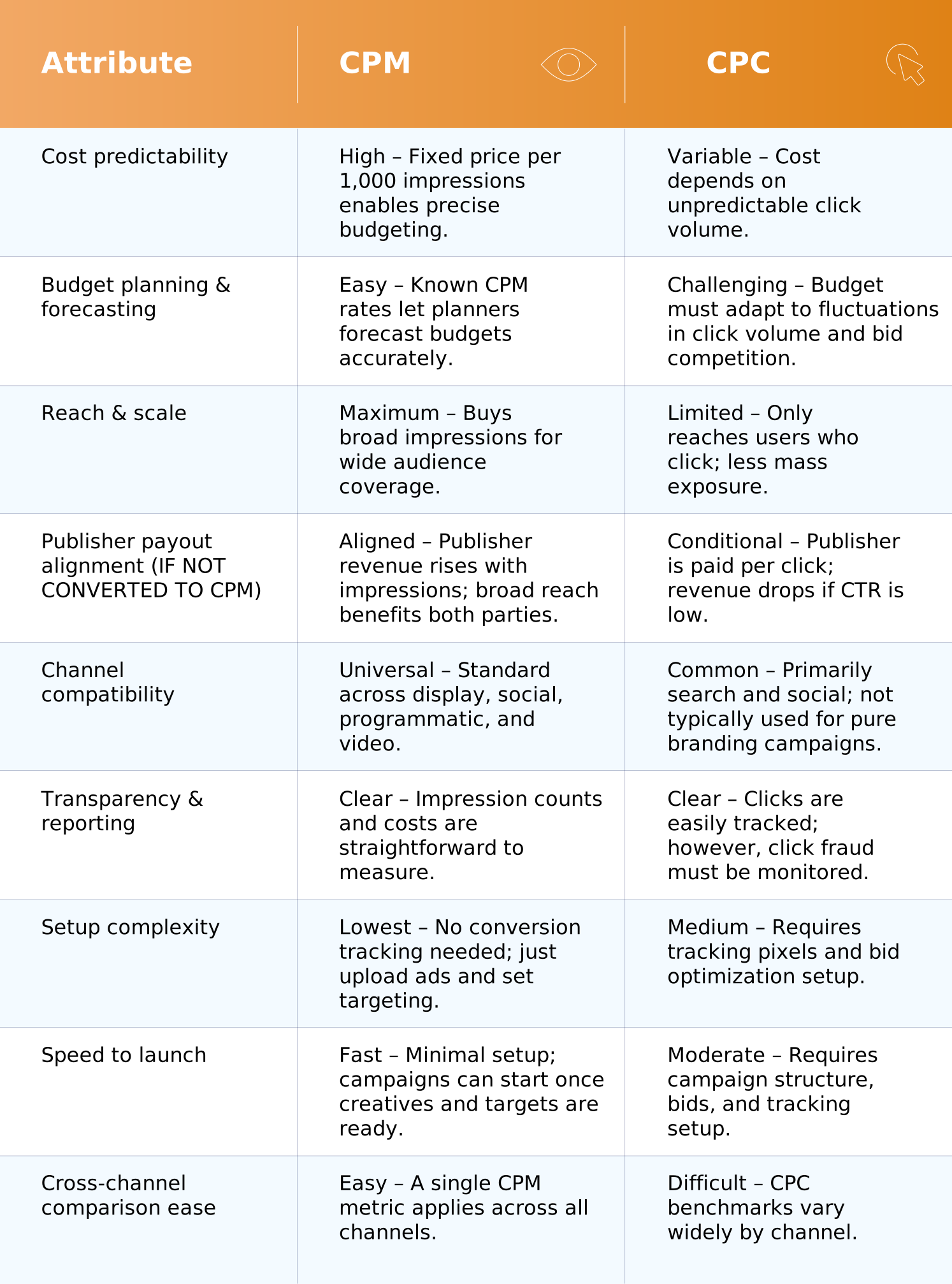
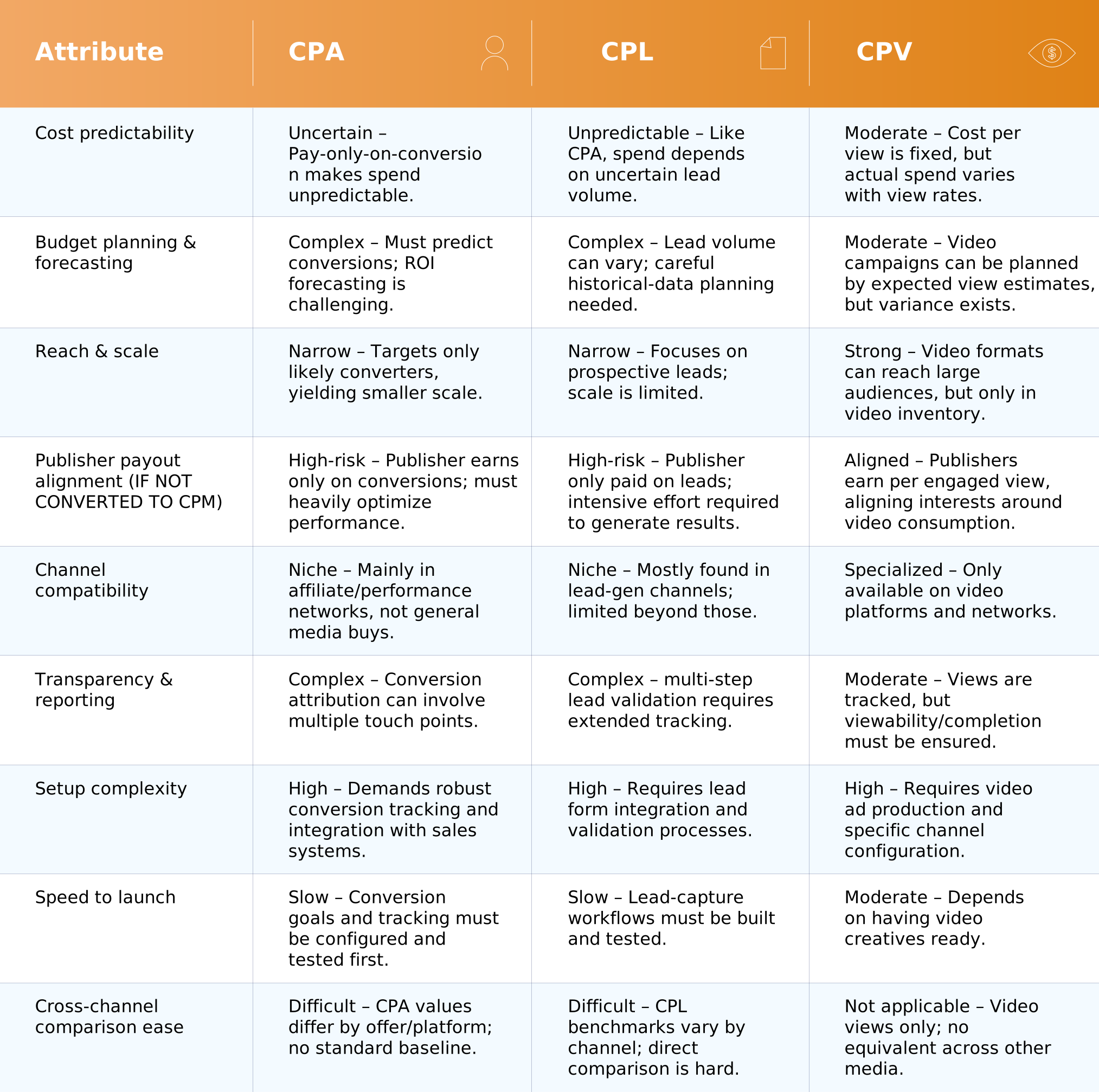
Another useful metric is effective CPM, or eCPM. While CPM describes an impression-based price, eCPM converts the economics of CPC, CPA, and other pricing models into an equivalent value per 1,000 impressions.
As a result, campaigns using different pricing models can still be compared on a common basis.
CPM Formula: How to Calculate CPM
The CPM formula is straightforward:
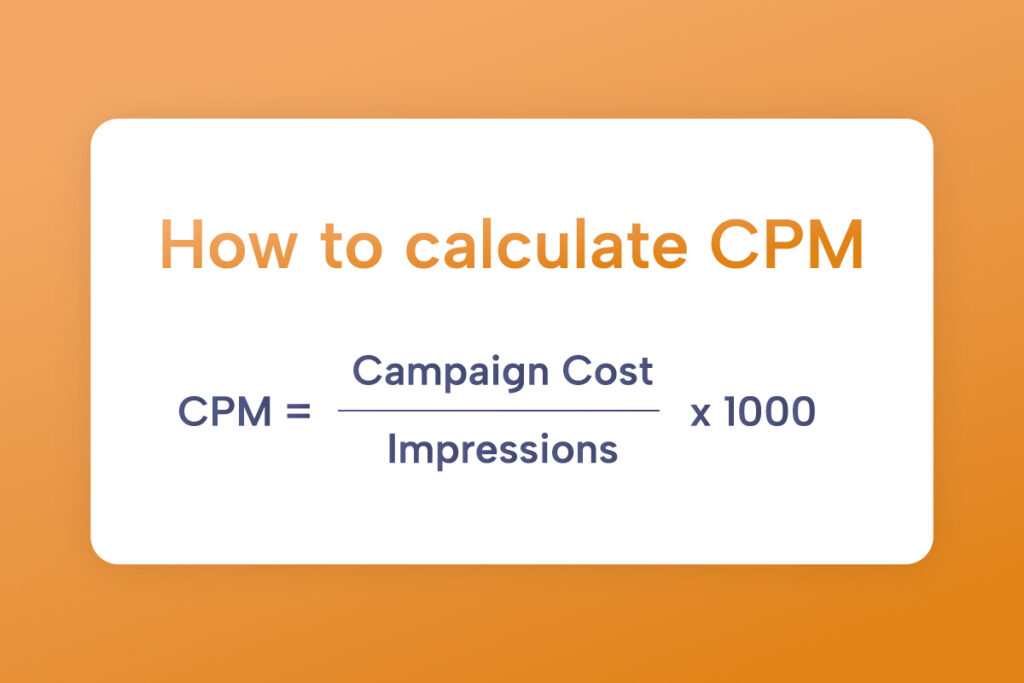
For example, suppose an advertiser spends $2,000 and receives 500,000 impressions:
($2,000 ÷ 500,000) × 1,000 = $4 CPM
In other words, the advertiser paid $4 for every 1,000 impressions.
You can also reverse the calculation to estimate how many impressions a particular budget could generate:
Impressions = (Advertising Budget ÷ CPM) × 1,000
For example, a $10,000 budget at a $5 CPM would theoretically purchase:
($10,000 ÷ $5) × 1,000 = 2,000,000 impressions
Actual delivery can vary depending on targeting, available inventory, and campaign conditions. Still, this simple relationship between budget, CPM, and impressions is one reason CPM remains useful for media planning.
Why Is CPM Still Important in Digital Advertising?

CPM remains important because impressions provide a common economic unit across an increasingly fragmented advertising ecosystem.
Advertisers may ultimately care about conversions and revenue, but advertising inventory still needs to be bought, sold, and valued before those outcomes can occur. CPM provides a practical way to do that.
CPM Creates a Common Value for Ad Inventory
Publishers, ad networks, demand-side platforms, supply-side platforms, and advertisers all need a consistent way to value exposure. CPM provides that common reference.
Even campaigns purchased through CPC or CPA models can be translated into eCPM. This allows both advertisers and publishers to understand how much a particular set of impressions effectively costs or earns, regardless of the original pricing model.
Therefore, CPM is more than an awareness metric. It also functions as a common economic language for digital advertising inventory.
CPM Makes Campaign Reach Predictable
If you know your budget and approximate CPM, you can estimate your potential impressions before launching or scaling a campaign.
That helps advertisers answer practical questions such as how much budget is required to reach a particular scale and whether a campaign can generate enough exposure within its planned timeframe.
This predictability is especially useful for awareness campaigns, product launches, retargeting, and campaigns that need significant reach quickly.
CPM Makes Advertising Channels Easier to Compare
Display, native, video, social, and programmatic advertising work differently. However, all of them generate impressions. CPM, therefore, provides advertisers with a useful first-level comparison of exposure costs across channels. The important word is exposure.
A lower CPM does not automatically mean a more efficient campaign. Overall performance still depends on who receives those impressions and what happens afterward.
Is CPM an Outdated Advertising Model?
No. CPM is an established pricing model, but that does not make it outdated.
Digital advertising has simply become much better at measuring what happens after an impression. Advertisers can now connect exposure with clicks, conversions, customer acquisition costs, revenue, and other performance indicators.
Instead of replacing CPM, these metrics give it more context.
Impressions Still Matter in Performance Advertising
Most performance funnels still follow the same basic sequence: Impression → engagement or click → conversion
The conversion may be the KPI that ultimately matters, but it cannot happen without exposure. That does not make impressions more important than conversions. It makes them an input.
A campaign can generate millions of impressions and still fail. CPM tells you what those opportunities cost. CTR, conversion rate, CPA, and ROAS tell you whether you used them effectively.
Modern Targeting Makes CPM More Effective
CPM buying today is not just about purchasing large quantities of impressions. Advertisers can combine CPM campaigns with contextual targeting, audience targeting, retargeting, first-party data, frequency caps, viewability optimization, and brand safety controls.
This changes the question from “How many impressions can I buy?” to “Which impressions are worth buying?”
For crypto advertisers in particular, context can matter considerably. An impression shown to a user actively checking market data or researching a blockchain product is not equivalent to an impression delivered on a general interest website.
Average CPM for Online Advertising in 2026
There is no universal average CPM for online advertising in 2026. Any useful CPM benchmark needs context because channel, industry, GEO, audience, objective, format, placement, and inventory quality can all influence the price.
For a broad reference point, a 2026 analysis estimates that digital advertising platforms typically cost around $3 to $10 per 1,000 impressions. However, that range should be treated as orientation rather than the CPM that every advertiser should expect.
Looking at individual channels makes the differences clearer.
| Advertising Channel | Latest Benchmark Context | Main Pricing Factors |
|---|---|---|
| Display Advertising | Google Display: $3.12 CPM | GEO, targeting, placement, viewability |
| Social Media Advertising | Meta global: $6.59 CPM | Platform, GEO, objective, competition |
| Video Advertising | YouTube video: $9.29 CPM | Format, device, placement, attention |
| Native Advertising | Standard native: $2 to $10 CPM | Publisher, audience, placement |
| Programmatic Advertising | Q1 2026 overall CPM: $4.42 | Supply path, quality, competition |
| Premium Programmatic | No universal CPM | Publisher, exclusivity, quality controls |
These figures come from different datasets and should not be compared as if they describe identical inventory. Instead, they provide reference points for understanding how widely impression costs can vary.
These benchmarks show the range, but they do not tell advertisers whether a particular CPM is expensive or cheap for their campaign. To understand that, you need to look at what creates the price.
What Affects CPM in Digital Advertising?

Two advertisers can pay very different CPMs even when they use the same advertising channel. Several factors determine how much a particular set of impressions costs.
Industry, Audience, and Advertiser Competition
Advertising inventory becomes more expensive when more advertisers compete to reach the same audience.
This is particularly noticeable in industries where each potential customer has a high commercial value. One 2026 industry benchmark reported a median CPM of $29.16 for U.S. finance advertising, compared with $2.82 for food and beverage.
Audience targeting creates a similar effect. Broad targeting gives advertising platforms more inventory to work with. In contrast, narrow or high-intent audiences can create scarcity. Reaching general technology readers, for instance, is usually easier than competing for a smaller audience of active investors or crypto users.
Therefore, a higher CPM can sometimes reflect access to an audience that is both more valuable and harder to reach.
Geographic Location
GEO can change CPM just as much as the industry. Markets with stronger purchasing power and advertiser demand usually cost more to reach. A 2026 country benchmark, for example, places Meta CPM at $23 in the U.S. and $2.60 in India.
This is why a cheaper CPM is not automatically better if the audience is less relevant to the campaign.
Device, Placement, and Ad Format
Where and how an ad appears can also affect its price. Desktop, mobile, and in-app inventory have different supply and engagement patterns, while prominent placements usually offer more visibility than ads positioned further down a page.
Format matters as well. Standard banners are often easier to scale, while native, video, and rich media placements can command higher CPMs because they offer more attention or use more limited inventory.
Seasonality and Advertiser Demand
CPM changes as advertiser demand rises and falls. During periods when more brands compete for the same inventory, prices can increase quickly. One digital advertising report estimates that costs can rise by around 20% to 40% during holiday periods.
Crypto advertising can experience similar pressure around major launches, industry events, and periods of strong market activity.
Viewability, Brand Safety, and Inventory Quality
Finally, not every impression offers the same value. Inventory with stronger viewability, verified traffic, transparent delivery, and better brand safety can justify a higher CPM because advertisers have more confidence that their ads are reaching real users in suitable environments.
Does a Higher CPM Mean Higher Quality Traffic?
A higher CPM simply means that you are paying more for 1,000 impressions. It does not automatically mean those impressions will generate better traffic or more conversions.
Still, higher CPMs can sometimes reflect inventory characteristics that advertisers value.
When Higher CPM Can Indicate More Valuable Inventory
Advertisers may pay more to access:
- Premium publishers;
- High intent audiences;
- Tier 1 GEOs;
- Better viewability;
- Scarce audience segments;
- Stronger brand safety;
- Premium placements.
These characteristics can increase the market value of an impression because more advertisers may be willing to compete for the same inventory.
However, inventory value remains relative to the campaign. An audience of active cryptocurrency traders, for example, may be extremely valuable to a crypto exchange but much less relevant to an advertiser selling an unrelated consumer product.
The real question is, therefore, not whether the audience is valuable in general. It is whether that audience is valuable to your campaign.
Why High CPMs Can Still Produce Poor Campaign Results
Even high-quality inventory cannot compensate for a campaign that fails to connect with its audience.
Poor targeting, weak creatives, an unclear CTA, excessive ad frequency, or a frustrating landing page can all reduce performance. As a result, advertisers may pay a premium for impressions and still see low conversion rates or an expensive CPA.
For this reason, CPM should never be evaluated on its own. Instead, it should be considered in the context of the results those impressions generate.
How to Evaluate Traffic Quality Beyond CPM
To understand whether a CPM is worth paying, advertisers need to look further down the funnel. Relevant metrics include CTR, CPC, conversion rate, CPA, ROAS, viewability, engagement quality, and post-click behavior.
Coinzilla’s campaign tracking follows the same principle by allowing advertisers to evaluate impressions alongside clicks, CPM, CPC, CPA, and other campaign metrics.
Consider two hypothetical campaigns:
- Campaign A: $5 CPM and $120 CPA;
- Campaign B: $15 CPM and $45 CPA.
Campaign B pays three times more for every 1,000 impressions. However, it acquires customers at a much lower cost.
In this situation, focusing only on CPM would make Campaign A look more efficient, while looking at the full funnel shows the opposite.
Instead of asking “Is my CPM too high?”, advertisers should ask: “Am I getting enough value from the impressions I am paying for?”
CPM vs. Other Pricing Models: CPC, CPA, and More
Direct Ad Sales vs. Programmatic CPM
How advertisers purchase impressions can also influence CPM.
Programmatic advertising uses automated systems to buy inventory, often through auction-based pricing. Direct advertising involves working with a publisher or advertising partner to agree on placements, inventory, pricing, and campaign terms.
| Factor | Direct Ad Sales | Programmatic Advertising |
|---|---|---|
| Pricing | Negotiated | Usually auction based |
| CPM | Fixed or negotiated | Dynamic |
| Inventory | Selected or premium | Broad to premium |
| Placement Control | Higher | Varies |
| Custom Campaigns | More flexible | More standardized |
| Guaranteed Delivery | Can be negotiated | Depends on buying method |
Neither method is automatically better.
Programmatic can provide scale and flexibility, while direct advertising can offer greater control over where ads appear and which audiences they reach. Consequently, a higher direct CPM may make sense when the premium gives the advertiser access to inventory that better matches the campaign.
When Direct Inventory Can Command a Premium CPM
Finance and crypto publishers are a useful example because they may already attract audiences such as traders, investors, and active cryptocurrency users. Still, being part of a valuable niche is not enough to justify a premium CPM.
Advertisers should look for evidence that the higher price comes with meaningful advantages, such as:
- Relevant audience demographics and first-party insights;
- Strong traffic quality in important GEOs;
- High viewability and prominent placements;
- Historical campaign performance;
- Brand safety;
- Guaranteed inventory or share of voice;
- Custom campaign opportunities.
The more information a publisher can provide about its audience, inventory, and past performance, the easier it becomes to determine whether the premium is justified.
Direct ad sales platforms such as Sevio Sales CRM can also help publishers organize inventory, offers, and direct campaigns in one place. For advertisers, this can provide greater transparency into the placements and inventory they are purchasing.
Ultimately, whether the inventory is bought directly or programmatically, a good CPM is not necessarily the lowest CPM. It is one that delivers enough value for its price.
FAQ
There is no universal good CPM. The right benchmark depends on the advertising channel, GEO, audience, format, competition, inventory quality, and campaign objective. Advertisers should also compare CPM with downstream metrics such as CPA and ROAS.
Yes, CPM stands for the cost an advertiser pays for every 1,000 ad impressions.
Ad networks prefer CPM because most publishers (70–80%) sell inventory this way. CPM ensures predictable revenue by paying publishers for impressions, not clicks, reducing risk for both sides. Publishers earn even without user engagement, unlike CPC or CPA, making CPM the industry standard.
CPM measures the cost per 1,000 ad impressions. RPM measures how much revenue a publisher actually generates per 1,000 pageviews or sessions, providing a broader view of monetization efficiency.
Ads with social extensions usually have higher CPMs because they attract more attention and generate stronger engagement signals. Social proof elements like follower counts, likes, or brand interactions increase credibility and visibility, making the ad more competitive in auctions. As a result, platforms price these placements higher because they tend to deliver better performance, longer view time, and stronger brand recall than standard ads.
Final Thoughts
CPM remains a key digital advertising metric in 2026, but the number alone does not tell the full story. The average CPM for online advertising varies by channel, GEO, audience, competition, format, and inventory quality.
More importantly, a higher CPM does not automatically mean better traffic, just as a lower CPM does not guarantee better value. Advertisers should look at CPM alongside conversions, CPA, ROAS, and overall traffic quality to understand what their impressions actually deliver.
The distinction becomes clearer when looking at long-term campaign results. A Coinzilla partnership with a major cryptocurrency exchange has generated more than 280 million impressions and over 480,000 clicks since 2021, showing how sustained exposure can be combined with measurable engagement when campaigns reach relevant crypto audiences.